

Lee Miller
From to
From April 10 to August 2, 2026, the Musée d’Art Moderne de Paris is featuring the largest retrospective devoted to Lee Miller in France in twenty years.
Initiated by the Tate Britain and in collaboration with the Art Institute of Chicago, the exhibition brings together roughly 250 vintage and modern prints, some of which have never been exhibited, offering a fresh perspective on her oeuvre.
A key figure of the international avant-garde, Lee Miller (1907, Poughkeepsie, United States - 1977, Chiddingly, United Kingdom) was by turns a fashion model, surrealist artist, portraitist, fashion photographer, and war correspondent accredited by the U.S. army. Long relegated to the role of muse, she is now recognized as one of the major twentieth-century photographers.
The exhibition follows her entire career, from her beginnings in New York to the war years in Europe, including her stint in Egypt and her life in London. It showcases the breadth of a body of work in which formal experimentation, visual boldness, and political engagement coexist.
Eighteen years after the last French retrospective at the Jeu de Paume, the Musée d’Art Moderne de Paris proposes an exhibition in six sections, combining both chronological and thematic approaches
The exhibition
The exhibition opens with a group of portraits of Lee Miller taken by some of the greatest photographers and filmmakers of the 1920s and 1930s. Lee Miller emerged as a prominent figure in late-1920s New York, first through her work as a fashion model. She became one of the most sought-after models for magazines, embodying the archetypical modern, emancipated and active woman. During her stay in Paris, her connections with the surrealists led her to play one of the leading roles in Jean Cocteau’s first film, The Blood of a Poet (1930- 1932).
The exhibition continues by examining the significance of her Parisian stay from 1929 to 1932. That period was marked by her encounter with Man Ray, with whom she became both apprentice and companion. Their intense collaboration explored the erotic power of the photographic medium and resulted in their joint discovery of solarization. What Lee Miller called “solarization,” also known as the Sabatier effect, is a technique in which a print or a negative is briefly re-exposed to light during processing. This produces a partial inversion of tones in the photograph, creating a dreamlike halo effect. Although the phenomenon was first observed in the 1840s, Man Ray and Lee Miller are often regarded as the first artists to use the technique creatively.
Lee Miller opened her own studio and worked as a photographer for Vogue, thereby asserting her desire for artistic independence. Her photographs, distinctive in their taste for oblique angles and unexpected juxtapositions, were exhibited in Parisian galleries alongside the major photographers of the time (Germaine Krull, Brassaï, and others).
This eventful period ended with her departure in 1932 for New York, where she opened a new studio. Her first solo exhibition was organized by the Julien Levy Gallery. There would not be any others during her lifetime. Her activity as a portraitist, the subject of one section, flourished and would continue throughout her long life, reflecting her numerous ties to artistic and literary circles.
In 1934, Lee Miller married the Egyptian businessman Aziz Eloui Bey and moved with him to Cairo. The photographs from this period are striking for the strength of the motifs, textures, and framing that structure the images. Far from exploring exotic themes, Miller focused instead on contrasting materials and forms, and on the perceptual shifts created by unusual camera angles.
In 1937, Miller’s encounter with the surrealist painter and poet Roland Penrose gradually distanced her from Egypt. She began spending more time in Europe in the company of her surrealist friends. In 1939, when the war broke out, she chose to stay in London and became increasingly involved in the British edition of Vogue as a fashion photographer. This section shows how she incorporated the ruins and bombings in London into her images. She also contributed to the publication Grim Glory: Pictures of Britain Under Fire in May 1941, which documented daily life during the Blitz, blending patriotic celebration with dark humor.
In the winter of 1942, Miller became one the few women photographers to receive war correspondent accreditation from the United States. From then on, she covered the conflict directly and devoted numerous features to the women involved in the war: nurses, members of the anti-aircraft defense, aviators, which were published in both the British and American editions of Vogue.
Several weeks after the D-Day landings in June 1944, she traveled across the Channel to follow the advance of Allied troops, and found herself on the front lines, notably during the liberation of Saint-Malo. Her photographs and articles exposed the violence of the conflict. The exhibition highlights the ways in which she set herself apart from conventional war reporting, through the tone she employed and her deeply personal commitment. Her eye and sensibility focused more on meaningful details than the broader theater of military operations.
In April 1945, alongside Life photographer David E. Scherman, Lee Miller traveled to Dachau and Buchenwald right after the liberation of the camps. Accompanied by an article (“Believe it—June 1945"), some of her shots published in Vogue convey her outrage. Lee Miller’s photographs were among the first to reveal the Nazi program of mass extermination to the general public.
On April 30, 1945, having just photographed the Dachau camp, Lee Miller set off to Munich and went inside Adolf Hitler’s apartment. In a fully staged photograph laden with symbolism, she posed in the dictator’s bathtub. Little circulated at the time, the image is now considered one of the most iconic photographs marking the end of the world conflict. Lee Miller photographed Europe and the Liberation until January 1946. These images reflect the pain and deprivation but also those left behind, such as women and children, at the Liberation. Miller confided to her editor: “I prefer to describe the devastation of ruined cities and wounded people rather than face the broken morale and shattered faith of those who thought that “things would go back to the way they had been.’”
In the following years, Miller struggled to recover from her experience of the war. The last section of the exhibition focuses on her settling down at Farley Farm House (Sussex) with Roland Penrose and their son Antony. Lee Miller first continued to make her reporting and fashion photographs for Vogue, but gradually stopped doing commercial work. In a more personal context, she kept making portraits of her family and friends, which reflect her ongoing involvement in the international avant-garde. Farley’s House, a reflection of the Miller-Penrose couple, became an important meeting place for artistic exchange where Lee Miller devoted herself to culinary experiments that pay tribute to the inventiveness of her friends.
The catalogue
The exhibition catalogue, published by Tate Britain for the occasion, has been adapted, translated, and reissued by Paris Musées. It has been conceived as a new authoritative work about the artist’s oeuvre. It features three essays expanding upon the themes addressed in the exhibition, written by Damarice Amao, curator in the photography department at the Musée National d’Art Moderne, Hilary Floe, chief curator at Tate Britain and curator of the Lee Miller exhibition, and Fanny Schulmann, chief curator at the Musée d’Art Moderne de Paris and co-curator of the Lee Miller exhibition. It also includes a text by the British author Deborah Levy.
The exhibition Lee Miller is organized by the Musée d’Art Moderne de Paris from April 10 to August 2, 2026, in collaboration with Tate Britain and the Art Institute of Chicago. The exhibition is on view at Tate Britain from October 2, 2025 to February 15, 2026 and will be held at the Art Institute of Chicago from August 29 to Decembre 7, 2026.
With the participation of Lee Miller Archives.
Supported by Sfil 
Lee Miller
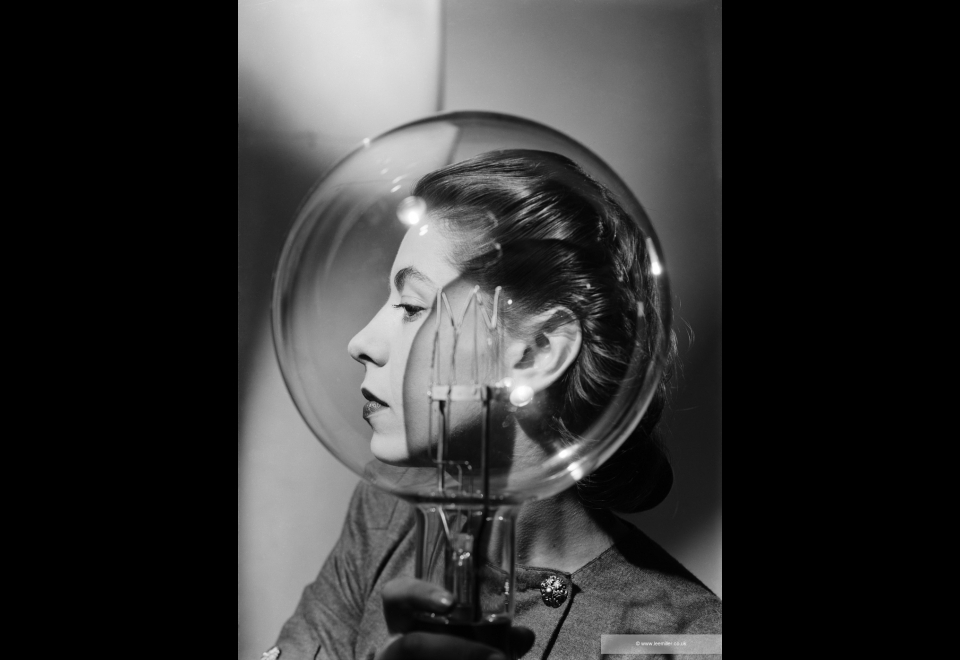
Lee Miller, Modèle avec une ampoule Model with Lightbulb Studio Vogue, Londres, 1943 Lee Miller Archives © Lee Miller Archives, England 2025 All rights reserved